How to Decode Food Labels: A Quick Guide for Everyday Shoppers
Most people look at the front of the package. That's where the marketing lives. But the ingredient list is where the food actually lives.
Here's how to read it quickly, without memorizing anything — and without turning every grocery trip into a research project.
Start with the First Ingredient
The first ingredient is what the product is mostly made of. That's it. That's the rule.
If the first ingredient is whole grain oats, you're mostly eating oats. If it's enriched white flour, you're mostly eating refined flour. If it's sugar — or corn syrup, or brown rice syrup — you're mostly eating sweetener.
The front of the package will never tell you this. The ingredient list will.
Before anything else, read the first ingredient.
Count the Sweeteners
One sweetener in a product is normal. Three or four is a strategy.
Ingredients are listed by weight, largest first. If a manufacturer lists sugar, brown rice syrup, and fruit juice concentrate separately, each one looks small. Together, they're a significant amount of added sweetener — just spread across three line items so none of them ranks high enough to alarm you.
Look for:
Words ending in -ose (sucrose, dextrose, fructose, maltose)
Syrups of any kind (corn syrup, rice syrup, malt syrup)
Concentrates (fruit juice concentrate, cane juice)
Natural sweeteners that still raise blood sugar (honey, agave, coconut sugar)
If you count three or more of these in one product, that's the pattern worth noticing — regardless of what the front panel says about fruit or whole grains.
Look at the List Length
A short ingredient list usually means a simpler product.
That's not a hard rule — some complex foods have short lists, and some simple foods have longer ones for legitimate reasons like fortification. But as a fast, practical signal in the store, it holds up more often than not.
If the ingredient list takes up the full panel and requires reading in two columns, it's worth pausing. Not to reject the product automatically, but to compare it with one alternative nearby. There's usually a simpler version of the same thing within arm's reach.
Short List, Recognizable Words
That's the green flag pattern.
Ignore the Front of the Package
"All natural." "Made with real fruit." "No added sugar." "High protein."
These phrases are not regulated the way you might assume. "All natural" has no FDA definition. "Made with real fruit" can mean 2% fruit. "No added sugar" means nothing was added — not that the product is low in sugar overall.
The front of a package is an advertisement. The ingredient list is the disclosure.
Treat them that way.
The 10-Second Routine
You don't need to do a deep dive on every product. You need a fast, repeatable check.
Here's the one that works:
Flip the package. Skip the front entirely.
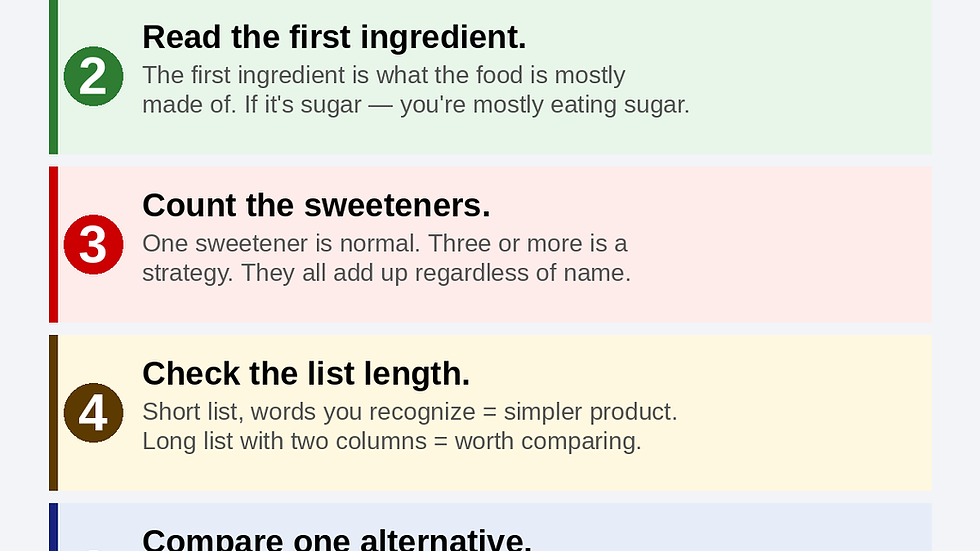
Read the first ingredient. Is it something you'd cook with at home?
Scan for sweeteners. How many are listed? Where do they appear?
Check the list length. Does it read like a recipe or a chemistry lab?
Compare one alternative. Pick the product with fewer additives and more recognizable ingredients.
Five steps. Ten seconds. That's the whole system.
What You're Actually Looking For
You're not looking for a perfect product. You're looking for the pattern.
Short list. Real ingredients near the top. No cluster of sweeteners, artificial colors, or preservatives stacked together in the first five items. When you find that pattern, you're usually in good shape — regardless of what the front panel is promising.
When you see the opposite pattern — long list, multiple sweeteners, artificial flavors high up, preservatives and stabilizers throughout — that's useful information too. It doesn't mean you can never buy the product. It means you're choosing it with accurate information rather than a label impression.
That's the goal. Not perfection. Just accuracy.
When You Want to Go Further
This routine gives you a fast way to spot the biggest label patterns without memorizing anything.
If you want to go deeper — specific ingredients by name, what they do, which ones are worth limiting and which ones just sound alarming — the Safe Food Signals guides are built for exactly that.
Each guide covers one area of the store: breakfast, snacks, drinks, dairy, kids' food, and more. They're designed to be used in the store, not just read once and forgotten.
Browse the full guide library in the Safe Food Signals shop.
Safe Food Signals guides are for educational purposes only and are not medical or dietary advice.
Comments